


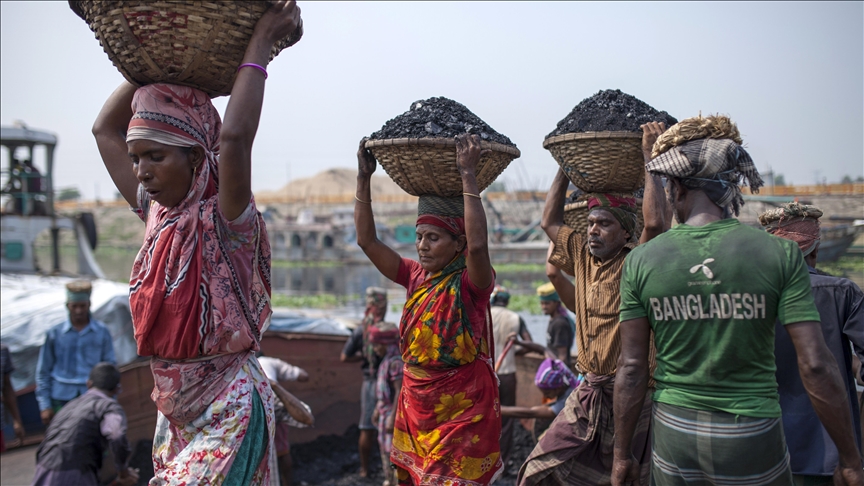
The Ready-made Garments (RMG) sector is one of the largest employers in Bangladesh, with over 3.4 million workers as of the 2022-23 financial year. It also accounts for more than 82% of the country’s export earnings. Despite the sector’s importance, the issue of wages has been a topic of much debate. The most recent revision of the minimum wage in the sector, after lengthy negotiations between owners, laborers, and the government, set the wage at 12,500 BDT per month. The actual average wage, however, stands at around 14,000 BDT. Studies have shown that a decent standard of living in Bangladesh requires a wage range of approximately 22,000 to 27,000 BDT.
Despite these contested wages, there are significant concerns within the sector, especially regarding the gender wage gap. Although the RMG sector is often celebrated for its large female workforce, women are consistently paid less than their male counterparts. An analysis of the 2022 Quarterly Labour Force Survey data revealed that, on average, men in the RMG sector earn 43% more than women. It is important to recognize that the wage difference is not solely due to gender. Many factors can contribute to these wage gaps, such as education, experience, and the type of work being performed. However, even after accounting for these factors, gender remains a significant driver of wage inequality in the sector.
Education plays a critical role in determining wages, and it is one of the key factors influencing salary differences. Workers with lower levels of education tend to earn less than those with higher educational qualifications. In the RMG sector, a significant portion of female workers have lower educational attainment, often with many having only a primary or lower level of education. On the other hand, male workers tend to have higher levels of education, with more men achieving secondary and tertiary qualifications compared to women. Along with education, work experience, location, and the type of work also contribute to variations in wages.
To understand the gender wage gap better, we can use advanced economic models that account for these differences in education, age, training, and occupation. After adjusting for these factors, we can isolate the portion of the wage gap that is caused specifically by gender differences. The results show that even after accounting for all these observable factors, there is still a significant portion of the wage gap that remains unexplained.
To get a clearer understanding of the wage gap, we analyzed the data based on different income levels, age groups, and localities. This approach goes beyond the average wage difference to examine how the wage gap varies across different income, age, and geographical categories. The findings were revealing.
When looking at the wage gap based on income quintiles, we see that the total wage difference between men and women increases as income levels rise. At the lowest income level (10th percentile), the wage gap is around 17%. However, at around the 90th percentile of income, the wage gap grows significantly to 61.3%. This indicates that as wages rise, the gender wage gap widens. Interestingly, the wage discrimination—that is, the portion of the wage gap that is caused specifically by gender differences—is lowest at the middle-income levels, but it peaks at the highest income level. This suggests that factors like education, experience, and training have a more significant impact on wages at lower income levels, while gender discrimination becomes more pronounced at higher income levels.
The reasons behind this variation are complex. Analysis of the data reveals that, above the 90th percentile of income, men tend to have higher levels of education, experience, and training compared to women, and the opposite occurs at lower quintiles. But even after accounting for these differences, women still earn less than men at higher income levels. This can likely be attributed to scale; as income levels increase, it becomes more costly for companies to pay higher salaries consistently across genders.
In addition to income levels, we also analyzed the wage gap across different age cohorts. The findings suggest the total wage difference between men and women increases with age and experience. For the youngest workers (ages 15-24), the wage gap is relatively modest at 13.4%, but it escalates significantly with age, reaching nearly 90.8% for the oldest workers (55+ years). When we look at wage discrimination, we find that it is lowest in the younger age groups, particularly among workers just starting their careers. However, wage discrimination peaks in the older age cohorts, particularly in the 44-54 age group.
Finally, we examined the wage gap across different localities and found some interesting trends. In urban areas, particularly in city corporations, the wage gap is smaller compared to rural areas. However, wage discrimination due to gender is actually higher in city-corporation areas than in rural areas. Surprisingly, peri-urban or municipal areas show both the highest wage differentials and the highest levels of gender-based wage discrimination, even higher than in rural areas.
These findings reveal that wage differences are far more complex and nuanced than the simple averages suggest. The system isn’t always on point about equality in the society, because we do not have clear information about the severity and extent of inequality. Understanding how wage inequality evolves across different income levels, age groups, and localities is crucial for creating more targeted and effective policies. It can help address the root causes of inequality and ensure that future wage policies are fairer and more inclusive for all workers, particularly women, in the RMG sector.