
The challenging arithmetic of poverty in Bangladesh

Bangladesh has made important progress in reducing poverty over the past one and half decades. According to the national estimates, the overall head-count poverty fell from as high
How do public education and health spending reduce poverty?
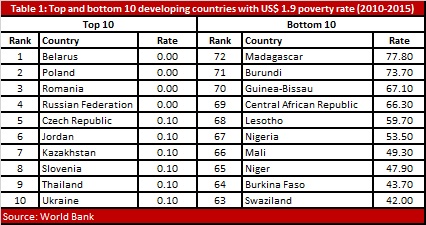
an recent decades, the developing world has made important progress in reducing extreme poverty. The data from the World Bank shows that the number of people living below the international poverty line of US$ 1.9 a day dwindled down from 1.85 billion people in 1990 to 768.5 million
Can Bangladesh continue to grow without ‘good governance’?
if we look at the growth pattern of Bangladesh from 1990, we discover two specific characteristics: first, the growth rate has been on the rise, and second, it is less volatile compared to those of many other countries (for example, India, Vietnam, Cambodia, China
Tapping on the trade-investment nexus for improving bilateral economic cooperation between Bangladesh and India

Bangladesh and India have long bonds in culture and history. Despite such bonds and neighborly proximity, economic cooperation between the two countries has remained far below potential. A number of studies have shown that bilateral trade and investment
Sub-regional cooperation can be the answer to the deadlock of regional integration in South Asia
Though there is a strong demand for deeper regional integration in South Asia, the progress has been rather slow. The actual implementation of agreements often does not match the declared ambitions, and in this context, lack of political will and leadership, institutional weaknesses
Cross-country differences in income inequality: Where do South Asian countries stand?

In recent years, there has been a growing interest among general people, researchers and policymakers in income inequality, its causes, and its effects. The most popular index of income inequality is the ‘Gini index’ which measures the inequality among levels of income
Does employment status matter for the wellbeing of rural households in Bangladesh?
In rural Bangladesh, a great challenge is to tackle the low pay, poor-quality jobs that are unrecognized and unprotected by law, widespread underemployment, the absence of rights at work, inadequate social protection, and the lack of representative voice
Dynamics of economic growth in Bangladesh

Rapid and sustained economic growth is very critical for Bangladesh’s economy in its way towards a middle-income country. In this article, we have investigated the major determinants of economic growth in Bangladesh using time series data for 44 years (1972-2015). We start with a production
Transitions between growth episodes: Do institutions matter and do some institutions matter more?
A large literature has examined the role of institutions in explaining economic growth. While the earlier literature has examined the role of institutions in determining long-run per capita income, a new literature examines the determinants of growth accelerations and deceleration episodes
Does institution matter for human capital development?

A fundamental proposition of new growth theories is that human capital is a key driver of economic growth. Development of human capital for the people of a country encompasses not only the diffusion and assimilation of available knowledge but also the generation of new knowledge


