


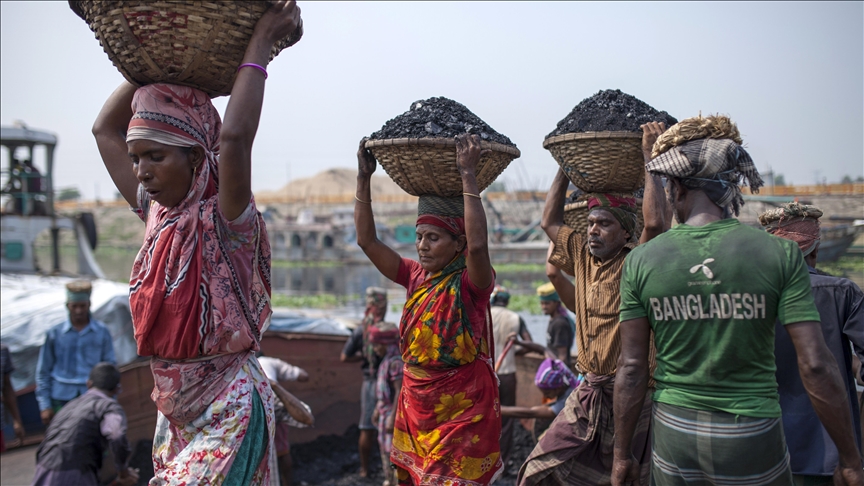
Moreover, Bangladesh is a densely-populated country with a population of 161.36 million in 2018 against 103.17 million in 1990. Population growth was showing a decreasing trend as it reached 1.05 percent by 2018 though it was 2.43 percent in 1990. In such a context, according to UN projection, the population size will be about 100 million by 2025 (UNESCO, 2009). Additionally, Bangladesh is a country with the highest rate of growth of urban population. Rural population growth was 1.83 percent, but from 2014 it became negative and touched minus 0.16 percent in 2018. Exactly when the opposite scenario was portrayed by the urban portion as in 1990 the growth rate was 4.89 percent, it fell in 2000 and stood at 3.61 percent. It went up again, hit 4.52 percent in 2002. Un 2018 it was 3.19, still big comparatively (World Development Indicators).
Since 1950, urbanisation has had a tremendous effect on developing countries. In Bangladesh urban population as a percentage of total population was 19.81 percent in 1990 and it stood at 36.63 in 2018. Other South Asian countries’ state in 2018 was as follows: Bhutan-40.9 percent, India-34.03 percent, Maldives-39.08 percent, Nepal-19.74 percent, Pakistan-36.67 percent, Sri Lanka-18.48 percent (WDI). According to the Human Development Report (UDP-2017), by 2050 more than two-thirds of the world population will start living in the urban areas. However, Africa and Asia both will have the fastest growth. By 2050 it is projected that Asia’s urban population will jump from 48 percent to 64 percent and for Africa, it will be 40 to 56 percent. In order to accommodate this rapid expansion in urban dwellings, experts estimate that US$57 trillion in global infrastructure investment is needed by 2030. As more than 1.0 billion people live in housing that is below minimum standards of comfort and sanitation, new houses will have to be built for 3.0 billion people by 2030.
Therefore, Bangladesh is facing an immense change because of rural-urban migration trend especially in the capital city of Dhaka. The unemployment rate was 4.2 percent in FY 2017-18 (BBS). So these young dependents are concerned about higher probability of employment opportunities. On the other hand, they set their mind to come to city for catching up with their dream. Although they are expanding food consumption and improving financial condition but in terms of housing condition their health is in danger, sanitation is far from the satisfactory level. There are social and economic costs of migration such as market failure, price hike, unhygienic environment, lack of drinking water, insufficient health care service, extreme congestion, juvenile crime, overcrowding, etc.
Furthermore, it has always been a challenge to develop the rural area with all amenities available in the urban area. As a labour-intensive country, it’s a gigantic challenge to accommodate this large labour force within the limited economic zone. At the moment when migration is increasing in a consistent manner, national attention should be paid to this issue for further development. Balanced rural-urban development can be achieved through poverty alleviation, increasing economic activity, relocating industry, infrastructural development, increasing employment opportunities, providing training for enhancing productivity of the rural poor. Again, economic and social investments in rural areas through introducing new technology in the agricultural sector, better health care, sanitation, and education opportunity, expanding income generating zone, improving vulnerable groups’ condition, establishing youth training centre and providing bank loans will be advantageous tools.
Finally, a policy framework for reverse migration will be a vehicle for promoting growth and alleviating poverty. Internal migration may be economically beneficial for the development. On the other side, it can be the cause of underdevelopment though judging the consequences of urbanisation is a difficult task to do. So, instead of a biased urban development policy, strategic policy formulation for the rural area can save the country from the grave consequences.