


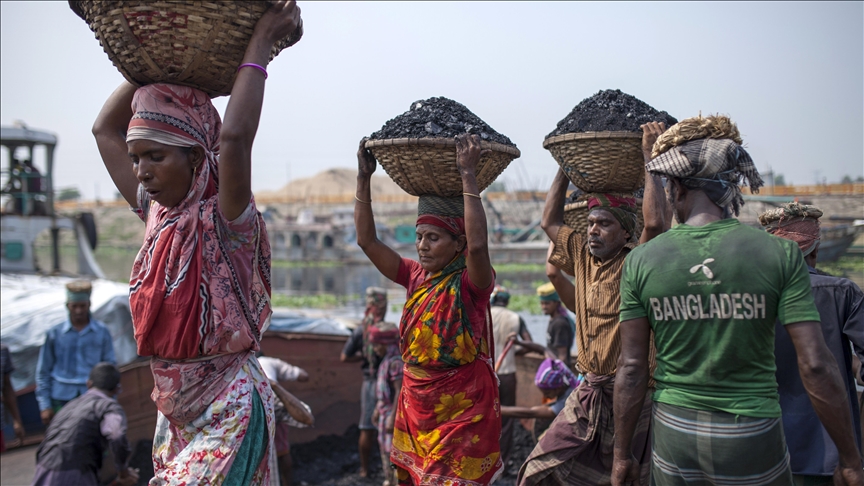
The volatility of commodity prices in both global and local markets has put ordinary people in Bangladesh in an uncertain situation as we slowly recover from the economic effects of the pandemic. The World Bank is already worried about famine in some countries. Given Bangladesh’s food reserves, we may not face a famine threat. However, the abnormal rise in food prices and the fall in real income for the average individual is placing significant strain on their ability to obtain necessary food. This pressure may become more pronounced in the coming days.
Bangladesh’s current inflation rate is the highest in 11 years. Inflation eats away real income, and as a result, ordinary people’s purchasing power declines. Due to rising inflation, not only marginalised people but lower-middle and middle-class people, too, are under great stress. People with limited income opportunities and those in the informal sector continue to suffer. The vast majority of people are in precarious conditions as income or wages aren’t being adjusted with high inflation. Many people are forced to rely on savings or loans to meet their day-to-day expenses. For many others, such options are also very limited.
Ordinary people are adapting in their own ways, cutting back on food spending and opting for less expensive, less nutritious food items. Since protein foods are more expensive, they are eating more carbohydrates like rice. The impact of this change in diet and lifestyle can be passed down through generations, with the potential for reduced productivity of future generations. Thus, in the long run, the risk of creating undernourished generations in the country increases. On the other hand, those in the middle class may be cutting back on education, services or entertainment. We saw this happen during the pandemic. And now the same thing is happening due to high inflation. All these will affect the social and economic development of our country.
Inflation is the cruellest “tax” for marginalised people. A Sanem analysis shows that marginalised people in Bangladesh face much higher rates of inflation than the official rate. Inflation at this time is 9-9.5 percent according to official statistics, which means the real inflation rate is likely above 10 percent for marginalised people. A large part of their income is spent on food products. Even if we consider the official number to be accurate, it is still very high. Another concern is that the inflationary conditions seem unlikely to improve soon.
The Bangladesh Bureau of Statistics (BBS) calculates inflation using an old base year (2004-05), which doesn’t reflect the current reality. And if inflation is not properly accounted for, policymakers may fail to take into account this reality, making it difficult to implement the right policy measures at the right time to alleviate the suffering of marginalised people.
There are several reasons for high inflation, such as abnormal rise in prices of many commodities, including food products, in the world market, rise in fuel prices, a significant imbalance between demand and supply in the domestic market, rise in transport costs, depreciation of the taka against the US dollar, unscrupulous traders taking advantage of supply shortages and unduly raising prices, and weak market supervision and monitoring by the government.
As we don’t have any power to fix global food and commodity prices, stronger and more effective measures should be in place to make our domestic front right. Domestic production of food needs to be increased substantially. Efforts should be there to find alternative import sources. Market monitoring needs to be strengthened to prevent the manipulation of commodity prices. Besides, food subsidies need to be increased for marginalised people.
The government’s social protection programmes for the underprivileged need to be expanded. For instance, the initiative to assist 10 million families is a commendable endeavour. However, the quantity of support provided each month falls short of what is needed. The number of families enrolled in this programme needs to be raised given the current circumstances. Implementation of the government’s social security programmes is challenging. We have seen that during the pandemic, five million families were announced to be paid Tk 2,500 each. But a sizeable portion of that population could not be supported because of listing errors and various other institutional problems. Under-allocation of resources, targeting errors, lack of coordination between ministries, corruption and institutional weakness, and non-availability of assistance to many of those eligible for aid are major problems in the social protection sector.
Prices of essential commodities such as rice, wheat, fish, meat, eggs and edible oil have risen sharply in the past few months. Many unscrupulous traders are trying to take advantage of the situation. To deal with this, the government needs to be vigilant on both demand and supply sides. It must enhance coordination among the relevant stakeholders, including traders. But it is, no doubt, a challenging task.
The supply of some other commodities, including food, is heavily dependent on imports, and the prices of these commodities are often beyond government control. To solve this, the government should think about whether there is any opportunity to temporarily lower import duty to reduce the prices of imported food and other daily necessities. In many cases, import costs increase due to inefficiencies in supply management, which must be dealt with effectively.
The article was first published in the Daily Star, on 11 September 2022