


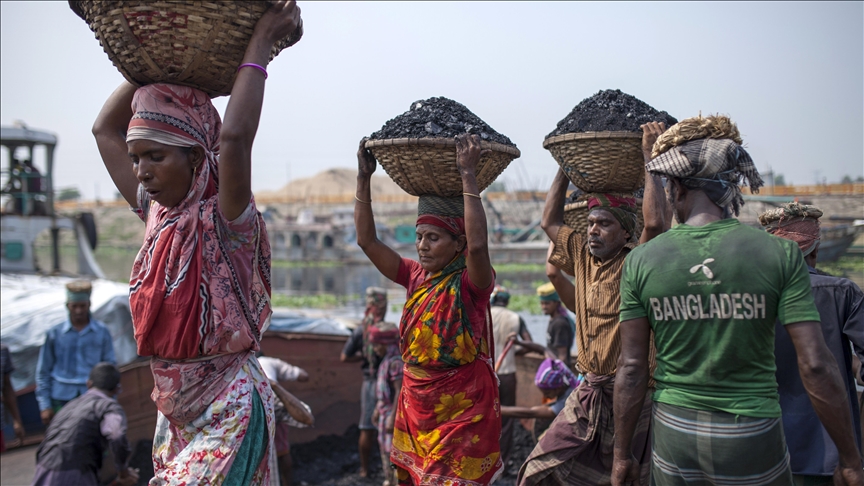
After 51 years of independence, one could say the success story of Bangladesh’s economic development has been spectacular. Over these years, the size of our economy has expanded manyfold; from a GDP of around USD 8.7 billion in 1971, we have grown to become a USD-416.3-billion economy now, along with achievements in a wide range of socioeconomic indicators.
Upon independence, we inherited a war-torn agrarian economy with poor infrastructure and an array of challenges in human development. The country’s journey has, however, been quite impressive as it has reached a per capita GDP of USD 2,734 and a steady growth rate of more than six percent per annum at least for a decade before Covid struck.
The country has also undergone a structural transformation in terms of its GDP components: the agriculture sector’s contribution has reduced to only 13 percent, with a gradual increase in the shares of the industry (35 percent) and service (52 percent) sectors. Over time, Bangladesh has also been able to reduce its head-count poverty rate to 24.3 percent in 2016-17 from as high as 50.1 percent even in the mid-90s.
Though it is difficult to single out the key drivers of our economic performance, there are certain factors that have especially helped to shape up the economy and contributed towards its development.
In this context, the contribution of agriculture to the economy should be acknowledged with due importance. During the 70s and particularly the 80s, innovations of different crop varieties by our scientists and the successful implementation of such innovations made the country self-sufficient in food. Making sustainable progress in food production while coping with the challenges of regular flooding has certainly helped to combat hunger, poverty and malnutrition. Another key contributor to the stable and consistently high economic growth is related to the export sector, particularly the ready-made garment (RMG) sector.
Today, Bangladesh is the second largest exporter of RMG products in the world; RMG has acted as a prime factor in generating manufacturing sector employment, especially for women.
The development narrative of Bangladesh would be incomplete if we did not take into account the contribution of the overseas migrant workers. On the one hand, from a macro point of view, foreign remittances have served as a key source of foreign currency, while on the other hand, remittances sent by the migrants have contributed to the economic well-being of the rural households.
Our rural economy has also been shaped by the expansion of small and medium enterprises, which particularly in recent years has contributed significantly towards generating small-scale self-employment.
Bangladesh’s economic journey has also been accelerated by the expansion of small-scale lending programmes, which have helped the rural households to gain access to the formal credit market, and thereby to engage in income-generating activities.
There are significant achievements in other areas of human development, too, such as education and healthcare. For example, the countrywide immunisation programme of children against a number of deadly diseases, which gained momentum particularly in the 80s, has arguably averted millions of child deaths and can be considered as a cornerstone of human development in the country. Several other noteworthy achievements in the social sector, which have significantly contributed to development efforts, are the low-cost treatments in combating diseases like diarrhoea and the expansion of the nationwide family planning programme.
There have also been impressive successes in ensuring education for girl children, enhanced especially by the secondary school stipend programme, which is said to have increased school attendance of girl students, delayed child marriage, and helped reduce fertility rate.
In addition to social development, there have been certain impressive infrastructural achievements, too, like the Jamuna Bridge, Padma Bridge, etc, which have contributed to the growth momentum of Bangladesh. These massive infrastructures have helped to redistribute the benefits of economic development to regions that are lagging behind, and contributed to bridging the east-west and north-south economic divides in the country.
There is no denying that there have been several drivers that have helped our economy to achieve a consistently high growth with impressive progress in poverty reduction as well as in a number of key indicators of health and education.
Despite such achievements, there remains questions regarding the quality of growth, with as high as 24.3 percent of population being unable to meet the basic necessities and as high as 27.8 percent of income being owned by the richest five percent of the country (according to the HIES 2016). Besides, there is an argument that the pace of employment generation has fallen behind the pace of economic growth, with the falling employment-elasticity of growth over the years. The impressive growth performance over the years is therefore argued to be overshadowed to some extent by the challenges in poverty reduction, employment generation, and inequality reduction.
The recent challenges of high inflation along with the depletion of foreign exchange reserves contested the hypothesis of stable macroeconomic performance of the country. Challenges also remain in the context of a number of institutional aspects, e.g. high non-performing loans (NPLs) and irregularities in the financial sector, inefficient public expenditure, and, more importantly, the low capacity of revenue generation to cover development expenses.
Despite such challenges, Bangladesh’s achievements over the years are definitely quite commendable, but in order to attain the future targets of high-income status and to attain the SDGs, much greater efforts are needed towards inclusive growth.
The article was first published in the Daily Star, on 11 September 2022