All Blog
Innovative, independent, peer-reviewed. Explore the latest economic research and policy proposals from SANEM’s global development experts.
- Blog Post
- Dr Selim Raihan
- Feb 3, 2026
- Blog Post
- Sultana Yeasmin
- Jan 15, 2026
- Blog Post
- Dr Selim Raihan
- Jan 7, 2026
Economic Impacts of AMR
SANEM set out to estimate the future economic burden of antimicrobial resistance (AMR) by 2050. We looked at the impact of AMR on four sectors of the economy: health system, the labour market, tourism, and domestic hospitality. We also estimated the return on investment of several interventions to prevent AMR.
Subscribe today to receive SANEM latest newsletters and topic updates.
All Blog
Filter
91 posts found
Topic
Author
Content Type
Time Frame
Governing emerging development challenges: A South Asian perspective
- Dr Selim Raihan
- Apr 18, 2019
espite the divergence in economic and political trajectories, South Asian countries share commonalities with respect to the urge for governing emerging development challenges in the wake of the new world and regional dynamics. As far as future economic and social developments are [....]
- Blog Post
The challenging economics of climate change
- Dr Selim Raihan
- Dec 9, 2018
Global climate change has become one of the dominant discourses in the scientific and public policy arena. Studies from scientific research show that the global warming is now a real phenomenon, as there has been an unusually rapid increase in Earth’s average [....]
- Blog Post
How does public investment affect private investment?
- Dr Selim Raihan
- Nov 18, 2018
he importance of investment in economic growth is well acknowledged both in theory and empirical literature. No country has been able to accelerate economic growth without significantly increasing the investment-GDP ratio. However, there are disagreements among economists [....]
- Blog Post
How do public education and health spending reduce poverty?
- Dr Selim Raihan
- Dec 4, 2017
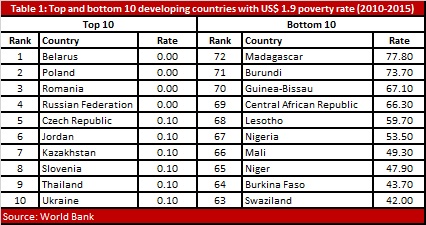
an recent decades, the developing world has made important progress in reducing extreme poverty. The data from the World Bank shows that the number of people living below the international poverty line of US$ 1.9 a day dwindled down from 1.85 billion people in 1990 to 768.5 million [....]
- Blog Post
Can Bangladesh continue to grow without ‘good governance’?
- Dr Selim Raihan
- Jun 3, 2017
if we look at the growth pattern of Bangladesh from 1990, we discover two specific characteristics: first, the growth rate has been on the rise, and second, it is less volatile compared to those of many other countries (for example, India, Vietnam, Cambodia, China [....]
- Blog Post
Cross-country differences in income inequality: Where do South Asian countries stand?
- Dr Selim Raihan
- Sep 10, 2016
In recent years, there has been a growing interest among general people, researchers and policymakers in income inequality, its causes, and its effects. The most popular index of income inequality is the ‘Gini index’ which measures the inequality among levels of income [....]