Publications
Innovative, independent, peer-reviewed. Explore the latest economic research and policy proposals from SANEM’s global development experts.
- Thinking Aloud
- Dr Selim Raihan, H. M. Shahariar, Sk Ashibur Rahman, Sunera Saba Khan, Zubayer Hossen
- December 1, 2018
- Thinking Aloud
- Dr Selim Raihan, H. M. Shahariar, Sk Ashibur Rahman, Sunera Saba Khan, Zubayer Hossen
- December 1, 2018
- Thinking Aloud
- Dr Selim Raihan, H. M. Shahariar, Sk Ashibur Rahman, Sunera Saba Khan, Zubayer Hossen
- November 1, 2018
Economic Impacts of AMR
SANEM set out to estimate the future economic burden of antimicrobial resistance (AMR) by 2050. We looked at the impact of AMR on four sectors of the economy: health system, the labour market, tourism, and domestic hospitality. We also estimated the return on investment of several interventions to prevent AMR.
Subscribe today to receive SANEM’s latest newsletters and topic updates.
All Publications
Filter
3 posts found
Author
Publications Type
Time Frame
- Thinking Aloud
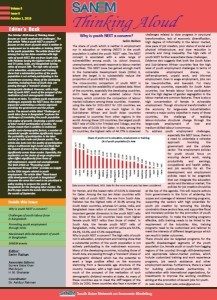
Thinking Aloud: Volume IV, Issue 9
- Dr Selim Raihan, Raisa Tamanna Khan, Sk Ashibur Rahman, Sunera Saba Khan
- February 1, 2018
This February 2018 issue of Thinking Aloud is a special issue on the 14th South Asian Economics Students’ Meet (SAESM). On January 18-21, 2018, SANEM, with the support from the World Bank and the Asia Foundation, organized the 14th SAESM in Chittagong, Bangladesh [....]
- Thinking Aloud
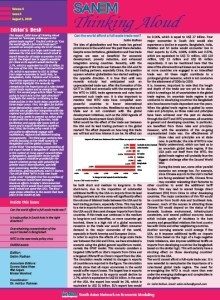
Thinking Aloud: Volume IV, Issue 8
- Dr Selim Raihan, Raisa Tamanna Khan, Sk Ashibur Rahman, Sunera Saba Khan
- January 1, 2018
This January 2018 issue of Thinking Aloud focuses on “Trade and Trade Policy”. The first article titled “The future of Bangladesh’s trade policy” argues that emerging challenges and complexities in the global trading regime call for an overhauling of the conventional thinking [....]
- Technical Paper
Rapid Assessment of Hazaribagh and Savar Tanneries, Dhaka
- Dr Bazlul Haque Khondker, Mohammad Moshiur Rahaman
- January 1, 2018
An overarching goal of Bangladesh is to attain high income country status by 2041. This will require achieving sustained economic growth of 8% to 10% over the next two decades. Expanding manufacturing export will be a key driver in this pursuit. In this context, along with Ready Made Garments, leather has [....]